

If you are a brand owner, a designer, or even a student doing a project on packaging, have you ever picked up a cereal box and wondered how big it actually is? The right size affects how your products are perceived on the shelves, how well they ship, plus how much cereal actually fits inside.
In this guide, we will break down the cereal box dimensions for your understanding. You will know about the standard sizes, how to measure the height, width, and depth, and what changes in dimensions for mini, regular, and family sized cereal boxes. We will also discuss real brand examples like Cheerios. By the end, you will know exactly what size works best for your product.
Standard Cereal Box Dimensions: A Quick Answer

A standard retail cereal box is about 12 inches tall, 8 inches wide, and 2 inches deep. In short, 12″ × 8″ × 2″ inches. This is the most common cereal box size in inches you will see on the retail shelves. It usually holds 12 to 18 ounces of cereal.
This size fits most store shelves in the USA. It also works well for shipping and storage. Many brands start here, then adjust for small cereal box or family size cereal box needs.
Common size chart (inches)
| Box type | Height | Width | Depth | Typical fill |
| Mini / single serve | 4.5 – 6.5 | 3 – 4 | 1.5 | 1 – 3 oz |
| Small | 9 – 11 | 6 – 7 | 1.75 – 2 | 8 – 10 oz |
| Standard | 12 | 8 | 2 – 2.25 | 12 – 18 oz |
| Large | 12.5 – 13.5 | 8.5 – 9.5 | 2.25 – 2.75 | 16 – 20 oz |
| Family size | 13.5 – 15 | 9 – 10 | 2.75 – 3.5 | 18 – 24+ oz |
| Giant / club | 14 – 16 | 10 – 11 | 3 – 4 | 24 – 30+ oz |
How to Measure a Cereal Box (Step by Step)
Measuring the box for cereals the right way can help you avoid mistakes. Follow these simple steps to get accurate cereal box measurements.
- Step 1: Flatten the flaps. Close the top and bottom flaps. Do not include open flaps in your box height.
- Step 2: Measure height. Place the box on a flat surface. Measure from the bottom to the top edge. This gives you cereal box height or how tall is a cereal box.
- Step 3: Measure width. Face the front panel. Measure across the front from left to right. This is the cereal box width.
- Step 4: Measure depth. Measure from the front panel to the back panel. This is the cereal box depth (sometimes called thickness).
Step 5: Check units. Make sure your tape or ruler uses the same units (inches or cm). Mixing units causes errors.

Common mistakes to avoid
- Measuring with flaps open (adds fake height).
- Measuring a crushed or bent box (use a new sample).
- Forgetting the inner bag (it takes space and affects fill).
- Using the wrong side as “width” (always measure the front face).
Cereal Box Sizes: Regular, Family, Small, and Giant
Brands use different sizes of cereal boxes to cater to their diverse packaging needs.

- Regular size cereal box
- Best for most retail SKUs.
- Strong shelf presence.
- Works with standard shipping cases.
- Family size cereal box
- Taller and has more depth than the regular one.
- Holds more ounces for bigger households.
- Needs stronger paperboard to avoid bending when half empty.
- Small cereal box
- Great for single serve, hotels, schools, and variety packs.
- Lower cost per unit.
- Good for trial sizes and promos.
- Giant cereal box
- Used for club stores and special promos.
- Needs careful design so it does not tip or bend.
Size vs fill note:
Two boxes can look the same but hold different cereal box weight because of density. Fluffy cereals need more space per ounce. Dense granola needs less. Always test with your actual product.
Height, Width, and Depth of a Cereal Box Explained
Each measurement affects how the box looks and performs on the retail shelf.
- Height of a cereal box
- Drives shelf visibility.
- Tall boxes catch the eye but can feel unstable if too thin.
- Width of a cereal box
- Controls the “billboard” area on the front.
- Wider fronts show more design art and brand name.
- Depth of a cereal box
- Affects how much cereal fits and how stable the box feels.
- More depth can mean more ounces can be stored without increasing the overall height.
When to change each dimension
- Want more shelf impact without more ounces? Increase width a bit and keep height similar.
- Need more fill but the same shelf height? Increase depth and adjust board strength.
- Need a compact SKU for promos? Reduce height and width, keep depth enough for a stable base.
How Much Cereal Fits in a Box? Ounces, Cups, and Servings
People often ask how many ounces in a box of cereal, how many cups of cereal in a box, and how many servings are in a box of cereal. The answer depends on the cereal type.
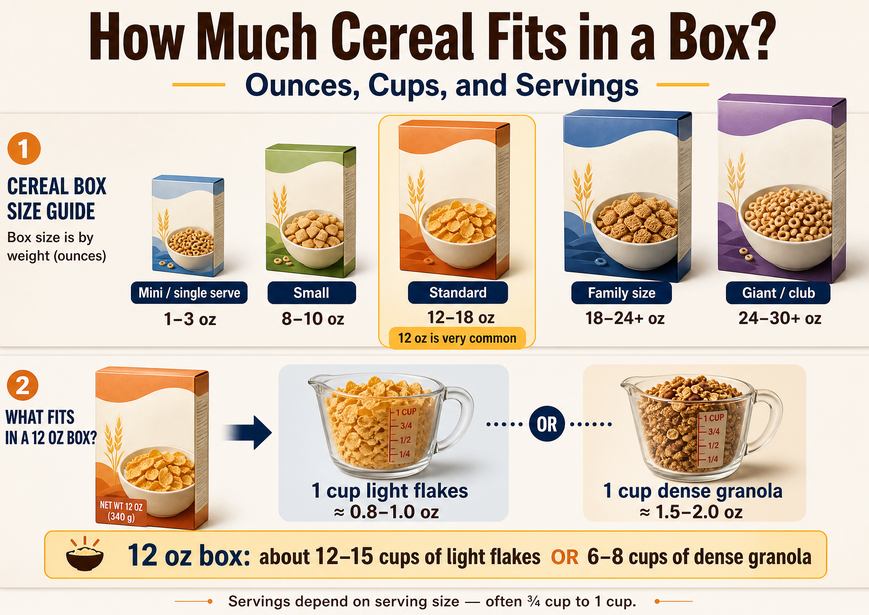
Typical ounce ranges
- Mini / single serve: 1 – 3 oz
- Small: 8 – 10 oz
- Standard: 12 – 18 oz (12 oz cereal box is very common)
- Family size: 18 – 24+ oz
- Giant / club: 24 – 30+
Cups and servings (rough guide)
Cereal density changes a lot. As a rough guide:
- 1 cup of light flakes ≈ 0.8 – 1.0 oz
- 1 cup of dense granola ≈ 1.5 – 2.0 oz
So a 12 oz cereal box might hold around 12 – 15 cups of light flakes, but only 6 – 8 cups of dense granola. Servings depend on the brand’s serving size (often ¾ cup to 1 cup).
Brand Examples: Cheerios and Common Boxes
Many people search for Cheerios box dimensions and how many Cheerios in a box. While exact numbers can change, here is the general idea.
- A common Cheerios box is close to the standard cereal box dimensions: about 12″ × 7.75″ × 2″.
- Small boxes of Cheerios are used in variety packs and single serve trays.
- Family size Cheerios use taller and deeper boxes to hold more ounces.
Cereal box panels and what goes on them
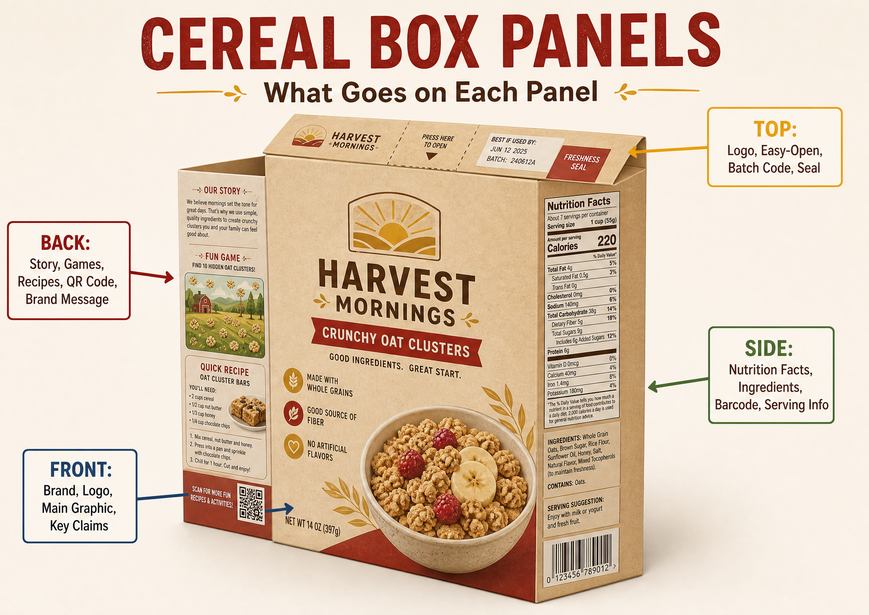
- Front of cereal box
- Brand name, logo, main graphic, key claims.
- Back of cereal box
- Story, games, recipes, QR codes, brand message.
- Sides of cereal boxes
- Nutrition facts, ingredients, barcode, serving info.
- Top of cereal boxes
- Logo, easy‑open hints, batch codes, seals.
These panels help you plan your cereal box design, layout, and cereal box ingredients display.
Materials and Styles for Cereal Boxes
Your material and style choices affect cost, the visual appeal, and security. Most cereal boxes use light but strong paperboard materials.
Common materials
- Cardboard (paperboard / SBS)
- Light, smooth, great for print.
- Most common for standard retail cereal boxes.
- Kraft
- Natural look, strong fibers.
- Good for kraft food boxes and eco‑friendly brands.
- Rigid
- Thick and premium.
- Used for gift sets or high‑end SKUs.
- Corrugated
- Strong and protective.
- Often used for outer shipping cases or heavy family packs.
Common styles and shapes
- Tuck boxes
- Simple tuck top and bottom.
- Clean look, fast to assemble.
- Great for many food boxes and snack SKUs.
- Gable boxes
- Handle on top, easy to carry.
- Good for multi‑serve, promos, and gift packs.
- Often used for mini popcorn boxes style packaging too.
- Rectangular cartons (standard cereal style)
- Tall, thin shape for strong shelf presence.
- Works with automatic filling lines.

Order Your Custom Cereal Boxes with Pack Heap
Ready to launch or upgrade your cereal line? Pack Heap makes Custom Cereal Boxes that fit your product and your brand. We serve brands across the USA with fast, reliable service.
Why choose Pack Heap?
- Lead time: 6 to 8 business days for production.
- Materials: cardboard, rigid, kraft, corrugated – pick what fits your SKU.
- Eco‑friendly options: recycled and recyclable boards, greener inks on request.
- Full support: from size advice to print ready files and samples.
We can help you choose the right cereal box dimensions, test fills, and create a box that looks great on shelf and ships safely. If you also need food boxes, tuck boxes, or gable boxes for other products, we can handle those too.
People Also Ask
How do I choose the right box size for a new cereal brand?
Start with your target fill weight (in ounces) and your cereal’s density if it is light to grainy. Test several sample boxes with your actual product packed inside them. Pick the smallest box that looks full and protects the product. This balances shelf appeal, cereal box cost, and shipping efficiency.
What box thickness works best for shipping cereal safely?
For most standard and family sizes, a sturdy paperboard or light cardboard works for retail. For heavier family size cereal box or giant cereal box SKUs, consider thicker board or corrugated options to avoid bending.
How do I design the front and back panels for retail compliance?
Plan your cereal box front for brand impact: logo, key claim, and main graphic. Use the back of cereal box for story, usage tips, and QR codes. Put nutrition facts, ingredients, barcode, and net weight on the sides or back as required by local rules.
What is the best way to test my cereal box before mass production?
Make a small run of sample boxes in your target size and material with Pack Heap. Fill them with your actual cereal and liner bag. Do three checks:
- Shelf test: does it look full and stable?
- Drop test: gently drop from a low height to see if it holds.
- Ship test: send a few boxes to yourself or a friend to see how they arrive.
Use the results to adjust size, board strength, or fill level.
How do I reduce cereal box cost without losing shelf appeal?
At Pack Heap, we recommend keeping the following three things in mind to keep the cost of cereal box as low as possible:
- Custom size your cereal box so you are not shipping empty air.
- Choose the lightest board that still protects your product.
- Simplify print where possible (fewer colors, standard sizes).