

Learning how to measure box dimensions takes about one minute, yet it is the step most buyers get wrong. A box that is a quarter inch too small will not close. Meanwhile, a box that is too large wastes board, filler, and shipping money.
First, this guide explains length, width, and height in the order box makers use. Then, it shows when to use inside or outside measurements. Finally, a calculator below works out volume, dimensional weight, and length plus girth for you.
Quick answer: To measure box dimensions, place the box with its opening facing up. Then, measure the longer side of the opening for length and the shorter side for width. Finally, measure from the opening down to the base for height. Always write the size as length x width x height, in inches.
Key Takeaways
- Box sizes always follow the same order, so write them as length x width x height.
- Length is the longer side of the opening, while width is the shorter side.
- Box makers quote inside sizes, because the inside decides whether your product fits.
- Carriers use outside dimensions, so measure the packed box again before you ship.
- Dimensional weight can raise your shipping bill, and therefore right-sizing saves money.
How Do You Measure Box Dimensions Step by Step?
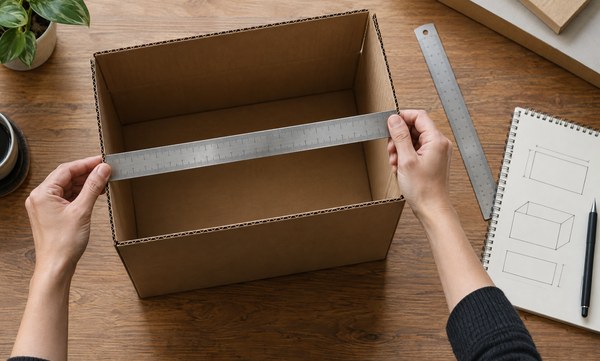
To measure box dimensions, measure the length, width, and height from the inside, in that order. However, set the box up properly first, because a flattened box gives false readings. Then, follow these steps.
- First, assemble the box and place it on a flat table with the opening facing up.
- Second, measure the longer side of the opening from inner wall to inner wall, because this figure is the length.
- Then, measure the shorter side of the opening the same way, since this figure is the width.
- After that, measure from the top edge straight down to the inside base. As a result, you get the height, which is also called depth.
- Finally, write the three numbers as L x W x H, and add the unit.
For example, a box that is 12 inches long, 10 inches wide, and 8 inches high is a 12 x 10 x 8 inch box. In addition, measure to the nearest 1/16 inch when the fit is tight.
What Do Length, Width, and Height Mean on a Box?
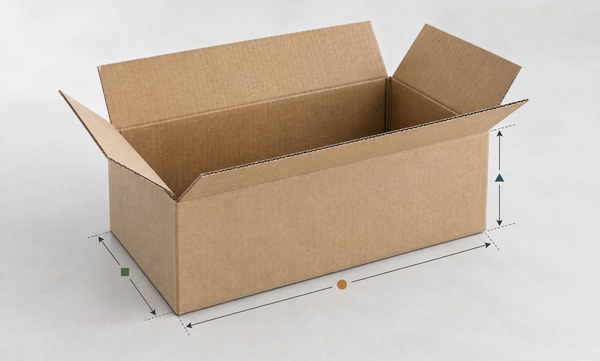
Length is the longer side of the opening, and width is the shorter side of the opening. Meanwhile, height is the distance from the opening to the base. Therefore, the opening decides which side gets which name. Because of this rule, you must find the opening before you measure box dimensions.
| Dimension | What it describes | Where to measure |
| Length (L) | Longer side of the opening | Inner wall to inner wall |
| Width (W) | Shorter side of the opening | Inner wall to inner wall |
| Height or depth (H or D) | Side perpendicular to the opening | Top edge to inside base |
Suppliers sometimes write depth instead of height. However, both words describe the same side. So, a mailer listed as 9 x 6 x 2 inches is 9 inches long, 6 inches wide, and 2 inches deep.
Why does the order of box dimensions matter?
The order matters because the same three numbers can describe different boxes. For instance, a 12 x 10 x 8 box opens on its 12 x 10 face. Meanwhile, a 12 x 8 x 10 box opens on its 12 x 8 face. As a result, the flaps, the print layout, and the price all change.
Should You Measure Inside or Outside Box Dimensions?
Measure inside box dimensions when you order a box, and measure the outside when you ship or stack it. According to Wikipedia’s article on corrugated fiberboard, boxes are usually specified and ordered by their internal dimensions. External sizes matter for handling and palletizing instead.

The gap between the two comes from board thickness. Therefore, thicker board means a bigger difference. The table below shows standard US flute thicknesses from the same source.
| Flute | Thickness (inches) | Thickness (mm) | Common use |
| A | 3/16 | 4.8 | Cushioning and stacking strength |
| C | 5/32 | 4.0 | Standard shipping cartons |
| B | 1/8 | 3.2 | Mailers and die-cut boxes |
| E | 1/16 | 1.6 | Retail and printed mailer boxes |
| F | 1/32 | 0.8 | Small retail cartons |
As a rule, each wall adds one board thickness. So, the outside length and width are roughly two board thicknesses larger than the inside. However, flaps add extra layers to the height, so ask your supplier for exact outside figures.
What Tools Do You Need to Measure a Box?
You need a tape measure or steel ruler to measure box dimensions, plus a flat surface. In addition, a few simple extras make the job more accurate.

- Tape measure: best for large cartons, because it reaches across long sides.
- Steel ruler: best for small boxes, since it sits flat against the inner wall.
- Digital caliper: useful when you also need the board thickness.
- Notepad or phone: record each number at once, so you do not mix up the order.
Avoid cloth tapes, because they stretch over time. Also, check that the hook on your tape measure is not bent.
How Do You Measure Box Dimensions for a Product?
To measure box dimensions for a product, measure the product first and then add clearance on every side. Therefore, the product sets the minimum inside size. Follow this method.

- First, measure the product at its longest, widest, and tallest points.
- Second, include anything that travels with it, such as a cap, a handle, or an inner bag.
- Then, add room for inserts, tissue, or padding.
- Finally, round up to a practical size and confirm it with a sample.
As a starting point, we suggest 1/8 to 1/4 inch of total clearance for a snug retail carton. However, fragile items need more space for cushioning on every side. In that case, decide on the padding first and then size the box around it.
Worked example
Suppose a candle jar is 3 inches wide, 3 inches deep, and 4 inches tall. After you add 1/8 inch of clearance to each side, the inside size becomes 3.125 x 3.125 x 4.125 inches. So, you would request a 3 1/8 x 3 1/8 x 4 1/8 inch box.
How Do You Calculate Box Volume and Dimensional Weight?
After you measure box dimensions, multiply length by width by height to get the volume in cubic inches. Then, divide by 1,728 to convert the result to cubic feet. Dimensional weight uses the same volume, but it divides by a carrier divisor instead.

Carriers bill on dimensional weight when a box is large but light. For example, UPS divides the cubic size by 139 for daily rates and by 166 for retail rates. Similarly, USPS divides by 166 for parcels larger than 1,728 cubic inches. Both carriers then round the result up to the next whole pound.
| Rule | UPS | USPS |
| Length | Longest side | Longest side |
| Girth | 2 x width + 2 x height | Distance around the thickest part |
| Dimensional weight divisor | 139 (daily rates) or 166 (retail rates) | 166, above 1,728 cubic inches |
| Maximum length plus girth | 165 inches | 108 inches for most parcels, 130 inches for USPS Ground Advantage |
| Rounding | Round each side up to a whole inch | Round each side to the nearest whole inch |
Carrier rules change, so always check the current rate guide before you quote shipping.
Example calculation
Take a packed carton that is 18 x 14 x 12 inches on the outside. First, the volume is 3,024 cubic inches, or 1.75 cubic feet. Next, 3,024 divided by 139 equals 21.8, so the dimensional weight is 22 pounds. Finally, length plus girth is 18 + 2 x (14 + 12), which equals 70 inches.
Box dimensions calculator
Enter the outside length, width, and height of your packed box in inches. Then, the calculator returns volume, dimensional weight, and length plus girth. It also rounds each side up to the next whole inch, as UPS does.
How Do Box Dimensions Change by Box Style?
Every style uses length x width x height. However, the opening sits in a different place on each one, so check the style before you measure box dimensions. Here is how the most common styles work.
Shipping cartons
A regular slotted carton opens at the top, so the top flaps mark the opening. Therefore, record the inside length, then the width, and then the height. Most corrugated cardboard boxes follow this pattern.
Mailer boxes
A mailer has a hinged lid and a shallow base. Therefore, the height is usually the smallest number. For example, a subscription brand might order custom mailer boxes at 9 x 6 x 2 inches.
Tuck boxes and retail cartons
A tuck box stands upright, and it opens at the top panel. So, the length and width describe the small top opening, while the height is the tall side. Also, size up custom tuck boxes while they are fully assembled.
Rigid boxes
A two-piece rigid box has a base and a separate lid. Therefore, check the inside of the base, because the product sits there. The lid of custom rigid boxes is then built slightly larger to slide over it.
Food and display boxes
Flat food boxes are wide and shallow. For example, our pizza box dimensions guide lists the length and width first and the shallow height last. Similarly, custom display boxes need the height of the back panel as well as the tray.

What Mistakes Should You Avoid When You Measure Box Dimensions?
The most common mistake is to measure box dimensions on the outside when the supplier needs the inside. However, several other errors cause wrong orders too.

- Mixing the order: always write length first, then width, and then height.
- Measuring a flat box: assemble it first, because folds hide the true size.
- Ignoring board thickness: thick board shrinks the usable space, so confirm the inside size.
- Forgetting inserts: dividers and padding take up room, so add them before you finalize.
- Mixing units: state inches or millimeters clearly, since a wrong unit ruins the whole order.
- Skipping the sample: test a physical sample before a full run, especially for tight fits.
How Do You Send Box Dimensions to a Packaging Supplier?
After you measure box dimensions, send the inside size as length x width x height, and state the unit. In addition, share a few details that help your supplier quote accurately.
- First, share the product size and weight.
- Second, name the box style, such as a mailer, tuck box, or rigid box.
- Third, choose the material, for example kraft boxes or white paperboard.
- Then, give the quantity and any inserts you need.
- Finally, say whether the box ships on its own or inside a carton.
Sizing from the product outward works in every category. For instance, our cereal box dimensions guide uses the same method for retail cartons. Likewise, custom gift boxes start with the size of the gift set.
Frequently Asked Questions
What is the correct order for box dimensions?
The correct order is length x width x height. Length is the longer side of the opening, while width is the shorter side.
Are box dimensions measured inside or outside?
Box makers use inside dimensions, because they decide product fit. However, carriers use outside dimensions to calculate shipping charges.
Is the length always the longest side of a box?
Not always. Length is the longer side of the opening, so a tall box can have a height that exceeds its length. However, carriers treat the longest side as the length.
How do you measure the depth of a box?
Measure from the top edge of the opening straight down to the inside base. Also, depth and height mean the same thing on most boxes.
How do you calculate the volume of a box?
Multiply length by width by height. Then, divide cubic inches by 1,728 to get cubic feet.
What is dimensional weight?
Dimensional weight is a billing weight based on box size. Carriers divide the cubic size by a divisor, such as 139 or 166, and then round up.
How do you measure girth on a box?
Girth is the distance around the box at its thickest part. Therefore, add twice the width to twice the height.
Conclusion
Once you know how to measure box dimensions, every order gets easier. First, record the inside length, width, and height. Then, write the numbers in that order. Finally, check the outside of the packed box before you ship, because carriers bill on size as well as weight.
Need a box built to your exact size? Packheap makes custom printed boxes in any dimension, material, and finish. Send us your measurements, and then our team will confirm the fit. Request a quote from Packheap today.