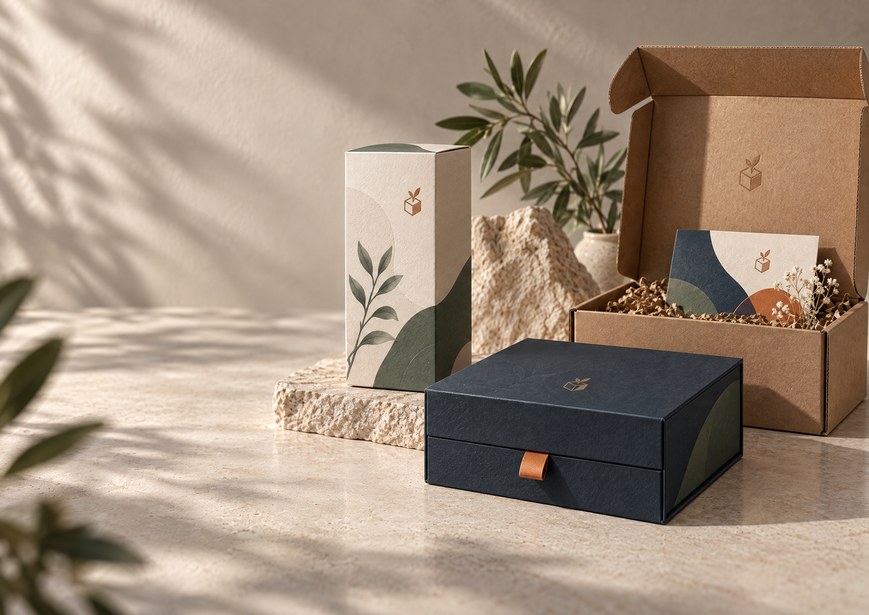
A face cream sold in a store and a gift set sent across the country need different kinds of packaging. One needs a neat folding box with enough room to print product details. The other might require a durable outer carton with inserts and a lid that makes the gift feel special.
That is why choosing between the types of custom boxes takes more than just picking a shape. The wrong box can lead to damage, higher shipping costs, and a poor customer experience. The right box protects your product, fits your brand, and keeps costs under control. You also need to know what the box will hold, how it will travel, and what it should do when the customer opens it.
In this guide, we make it simple to choose custom boxes. You will learn the main styles of custom boxes, how each one works, and how to choose the best fit for your product. We will cover folding cartons, rigid boxes, corrugated boxes, and a few other useful box packaging options. We will also look at materials, eco‑friendly options, and common mistakes to avoid. By the end, you will know exactly how to match a box to your product and your brand.
A Quick Guide to Choosing a Custom Box
Start by deciding what job you want the box to fulfil. Is it for displaying the product on the retail shelf, for shipping in mail, or both? Folding cartons, rigid boxes, and corrugated boxes serve different roles, though they can work together.
The best way to choose a box is to start with your product. Ask three simple questions:
- Is your product heavy or fragile? If yes, you need a stronger box like corrugated or rigid.
- Where will you sell it? Retail shelves need folding cartons or display boxes. Direct‑to‑consumer (DTC) needs mailer boxes. Wholesale needs corrugated shipping boxes.
- What unboxing experience do you want? Basic and functional, branded and pleasant, or luxury and premium?
Box Type Overview
| Your main need | Box type to consider | What to check |
| Pack a light item for a store shelf (cosmetics, supplements) | Folding carton | Product fit, base closure, label space |
| Send an online order in a branded box (DTC ecommerce brands) | Corrugated mailer | Board strength, padding, secure closure |
| Ship several items or bulk orders | Corrugated shipping box | Total weight, stacking, empty space |
| Present a premium gift (glass, electronics) | Rigid box | Insert fit, storage space, outer protection |
| Hold small items on a shop counter | Display box | Loaded weight, shelf fit, easy access |
These are starting points, not fixed rules.
Moving forward, let’s discuss each one of the types of boxes in detail.
The 3 Main Box Categories
Almost every custom box falls into one of three main categories: folding cartons, rigid boxes, or corrugated boxes. Each has its own strengths, costs, and best uses.
| Category | Material | Strength | Best use | Relative cost |
| Folding cartons | Thin paperboard | Low to medium | Light retail items | Low |
| Rigid boxes | Thick chipboard + printed wrap | High | Luxury gifts, premium sets | High |
| Corrugated boxes | Fluted cardboard | Medium to very high | Shipping, bulk, e‑commerce | Low to medium |
Most brands use a mix of these three, not just one.
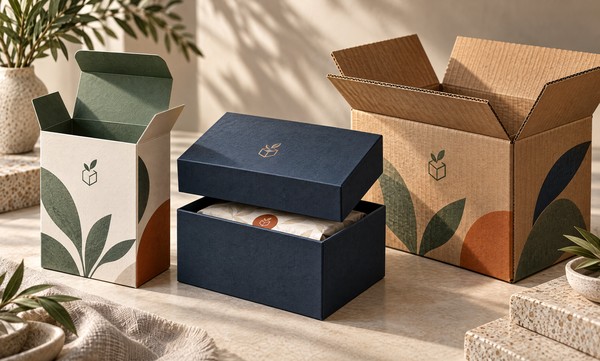
For example, a cosmetics brand might use a folding carton for the retail box, a rigid box for a gift set, and a corrugated shipper for bulk orders.
Folding Cartons (Product Boxes)
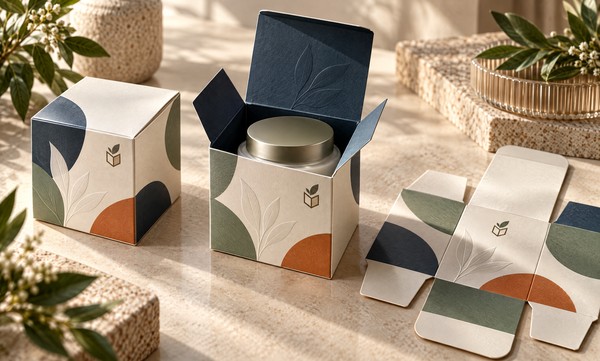
Folding cartons are the most common type of tuck-end boxes you see on retail shelves. They are made from thin paperboard, printed with your design, then folded and glued. They ship flat, which saves space and cost.
Common folding carton styles
- Straight tuck end: Both main flaps tuck in from the same side.
- Reverse tuck end: The top and bottom flaps tuck in from opposite sides.
- Auto-lock bottom: A pre-glued base opens into place as the carton is formed.
- Snap-lock bottom: Base flaps fold together by hand.
- Sleeve: An open-ended wrap slides around a tray or product.
The box closure matters as much as the print. A tuck-end carton might suit a light product, but a heavier jar requires a more stable base.
Best for
- Cosmetics and skincare
- Supplements and vitamins
- Small food items (cereal, tea, snacks)
- Personal care products
Pros
- Low cost per unit
- Ships flat, saves storage space
- Great print quality and branding space
- Easy to assemble
Cons
- Not strong enough for heavy or fragile items on their own
- Usually needs an outer corrugated shipper for transport
When to choose a folding carton
Select folding when you need clear print, product details, and a compact retail pack. It can work well for a bottle, jar, or sealed food bag.
Don’t opt for folding cartons if your main purpose is shipping a fragile product. It could increase the demand for an insert as well as an outer corrugated box.
Rigid Boxes (Premium Set‑Up Boxes)
Rigid boxes are thick boxes that do not fold or bend. They are made from heavy chipboard and wrapped with printed or decorative paper/overwrap. They feel premium in the hand and are usually used for giving a deluxe feel to high-end products.
Common styles of rigid boxes
- Two‑piece box: Separate base and lid. Classic, simple, and elegant.
- Magnetic closure box: Hidden magnets for a secure and premium closure. Great for high‑end gifts and tech.
- Drawer box: Slides open like a drawer. Stylish and good for jewelry or premium skincare.
- Book‑style box: Opens like a hardcover book. Great for limited editions and launch kits.
- Shoulder‑neck box: Has an inner tray (neck) between base and lid. Adds depth and a premium reveal.
- Collapsible rigid box: Folds flat for shipping but assembles into a strong premium box. Saves space and cost.

Best for
- Luxury gifts and premium cosmetic sets
- High‑end electronics and gadgets
- Limited editions and high‑margin hero products
- Jewelry and premium accessories
Pros
- Premium look and feel
- Strong protection
- Reusable, which keeps your brand in the customer’s home
- Great for unboxing experiences
Cons
- Higher cost per unit
- Takes more space to store and ship
- Usually needs an outer corrugated shipper for long‑distance transport
When to choose rigid boxes
Choose rigid packaging when the box itself is part of the product experience. It can suit a gift that the buyer plans to keep or present to someone else.
The only thing which makes them unfavorable is added cost and, for set-up styles, more storage space. A rigid gift box may also need a corrugated outer shipper. Its firm walls do not remove the need to protect glass, liquids, or delicate parts inside.
Corrugated Boxes (Shipping Cartons)
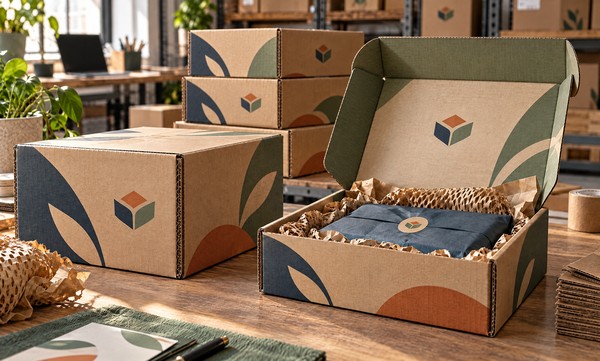
Corrugated boxes are made from cardboard with a wavy middle layer (called fluting) between two flat layers. This structure makes them strong and good at absorbing shocks. They are the classic “brown box” most people think of for shipping.
Common styles
- Regular slotted container (RSC): Standard box with flaps that meet in the center. Most common for shipping.
- Full overlap container (FOL): Flaps fully overlap for extra strength. Good for heavy or fragile items.
- One‑piece folder (OPF) / book fold: Wraps around flat items like books or documents.
- Shipper Display box: Has perforations that tear away to make the product visible and perfect for display. Good for snacks, small cosmetics, and impulse buys.
Best for
- E‑commerce and DTC orders
- Subscription boxes and curated kits
- Bulk shipping and wholesale
- Retail displays and point‑of‑purchase
Pros
- Strong and protective
- Stackable and easy to store
- Cost‑effective for shipping
- Mailer boxes offer good branding space
Cons
- Plain corrugated boxes look less premium than rigid boxes
- Need custom printing and finishes to look polished
When to choose a shipping carton
Use one when transport and protection is the main task. It can hold several retail packs, protect a gift box, or carry a single bulky item.
Do not choose by size alone. Two cartons with the same measurements have different use cases. A larger box is not always safer. If the contents slide around inside it, then an extra board on the outside cannot solve the problem. Inserts still matter in this situation.
Mailer Boxes for Online Orders
A mailer box usually has a hinged lid, side flaps, and tabs that hold its shape. It offers a neat opening experience and space for print on the outside and, where available, the inside.
Mailers are worth considering for:
- Clothing and accessories.
- Subscription packs.
- Small product bundles.
- Branded launch kits.
- Online orders where presentation matters.
What to check before choosing one
Check the product’s fit, the loaded weight, and the closure. A mailer box fold together without glue or tape, but that does not mean every product should ship without a seal.
Fragile goods may still need padding or a fitted insert. Mailers require inner protection for breakable products.
A mailer is not always stronger or weaker than a standard shipping carton. That depends on its size, board, design, and what is packed inside.
Display Boxes and Special Shapes
Display boxes hold several products where shoppers can see and reach them. Some stay on POS counters. Others open from a closed transport pack into a shelf-ready tray.
Check the display with products packed. It should stay upright, fit the shelf, and remain tidy as items are removed.
Other shapes can serve more specific needs:
- Gable boxes have a top handle and can suit carry-away gifts or event packs.
- Pillow boxes have curved ends and can suit small, light items.
- Window boxes let shoppers see part of the product.
- Hanging cartons use a hanging tab for peg displays.
For flat items, a rigid mailer envelope is a good option instead of a box. It can help resist bending, but it offers less room for cushioning than a full carton.
How to Choose the Right Box Type (5 Simple Questions)
Use these five questions to narrow down your choice fast.
Question 1: How heavy and fragile is your product?
- Light and not fragile: Folding carton, mailer envelope, or basic mailer.
- Heavy or fragile: Corrugated shipping box, strong mailer, or rigid box with inserts.
Question 2: Where will you sell and ship?
- Retail shelves: Folding cartons or display boxes, plus shippers for transport.
- Direct‑to‑consumer: Corrugated mailer boxes or rigid mailers, depending on weight and experience goals.
- Wholesale / B2B: Corrugated shipping boxes to send multiple items in one pack.
Question 3: What unboxing experience do you want?
- Basic and functional: Simple shippers or mailer envelopes.
- Branded and pleasant: Printed corrugated mailers or folding cartons.
- Luxury and “keepable”: Rigid boxes with inserts.
Question 4: Storage and shipping limits?
- Limited storage, need flat‑pack: Folding cartons, corrugated shippers, or mailers.
- Fine with more volume for premium feel: Rigid boxes.
Question 5: Budget per unit and product margin?
- Everyday or low‑margin products: Folding cartons and simple corrugated boxes.
- High‑margin or hero SKUs: Rigid boxes with inserts and specialty finishes.
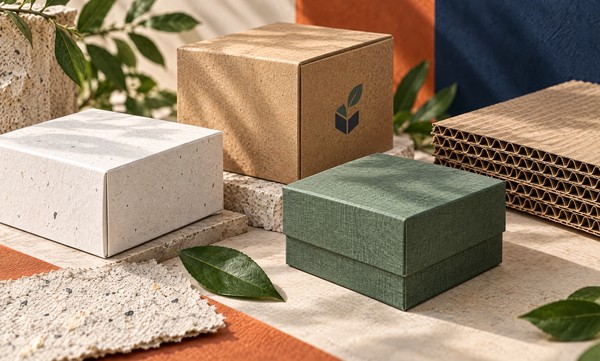
Material Matters: Cardboard, Kraft, Rigid, Corrugated
The material you choose changes how the box feels, costs, and protects. Here is a simple breakdown.
- Cardboard (paperboard / SBS): Thin, smooth, great for print. Most common for folding cartons and retail boxes.
- Kraft: Natural brown look, strong fibers. Good for eco‑friendly brands and kraft food boxes.
- Rigid: Very thick chipboard wrapped in printed paper. Premium feel, strong, but costly.
- Corrugated: Fluted cardboard, strong and protective. Best for shipping and bulk.
At Pack Heap, we offer all four materials, so you can match the material to your product and budget. If you are not sure which to pick, our experts are available for your assistance.
Order Your Custom Boxes with Pack Heap
Need a box that fits your product and your brand? At Pack Heap, we create custom boxes for brands across the USA. We help you choose the right type, material, shape, and size for your product packaging and branding needs.
Why choose Pack Heap?
- Lead time: 6 to 8 business days for production.
- Materials: cardboard, rigid, kraft, corrugated. Pick what fits your product and budget.
- Eco‑friendly options: recycled and recyclable boards, greener inks on request.
- Full support: from size advice to print‑ready files and samples.
Need help in making a perfect decision? Tell us your product type, target channel, and design goals. We will suggest the best custom box type for your needs and send you a clear quote.
Conclusion
In this guide, we discussed the main types of custom boxes and how to choose the right one from three main categories (folding cartons, rigid boxes, corrugated boxes), their common styles, and their best uses.
If you want a custom boxes wholesale that fits your product and your brand, Pack Heap can help. We serve USA brands with fast turnaround, quality materials, free shipping, and full customization freedom.
FAQs
What is the difference between a mailer box and a shipping box?
A mailer box is a one‑piece, self‑locking box with a tuck‑in lid. It is designed for DTC e‑commerce and unboxing experiences. A shipping box (like an RSC) is a taped‑flap carton designed for strength, stacking, and bulk shipping. Mailer boxes look better and need no tape. Shipping boxes are cheaper and stronger for heavy loads.
Can I use one box type for all my products?
You can, but it is not always the best idea. Different products have different needs. A light cosmetic item might work in a folding carton, while a heavy glass jar needs a corrugated or rigid box. Most brands use a mix of box types across their product line.
How do I know if I need inserts?
If your product is fragile, has multiple parts, or needs to stay in place during shipping, you need inserts. Inserts hold products in place, separate items in a kit, and improve presentation. Even a simple cardboard insert can make a big difference in protection and unboxing.
What is the most cost‑effective box type for a new brand?
For emerging DTC brands, a printed corrugated mailer box or a simple folding carton is the best point to start. These balance protection, branding space, and cost better than rigid boxes. As your brand grows, you can add rigid boxes for your highend products.
Relevant and Professional Guide: How to Measure Box Dimensions